-12 Minute Read-
There’s a moment every performer experiences — the pause before action, the hesitation before confidence, the voice before courage. It’s the space where fear resides.
Fear is universal, but how we respond to it defines us.
Fear can hold you hostage… or it can become your greatest teacher.
We all face it. Even the greats.
In 2021, Simone Biles — one of the most decorated gymnasts in history — made the courageous decision to step away in the middle of the Tokyo Olympics. After four years of training for that one opportunity, she chose to follow her intuition and protect her mental well-being.
Biles told reporters she withdrew after her vault because she was “struggling with some things.” She went on to open up about the immense pressure of being an Olympic athlete, saying: “I don’t twist (on tour). I do double lay half-outs, which is my signature move on the floor. That’s never affected me. But everything weighed so heavy… I’m still scared to do gymnastics.” — Simone Biles, U.S. Olympic Gold Medalist
Why I’m Writing About Fear
For many years, I’ve worked with professional athletes and high achievers who prepare their bodies and skillsets with precision, yet the one thing that quietly holds them back isn’t physical — it’s psychological.
Fear is the silent opponent every human being and performer faces — not just in competition, but in life. I’ve seen it in locker rooms, weight rooms, surgical rooms, and even draft night war rooms.
This psychological warfare that battles within us isn’t always the easiest obstacle to name or tame. And even if we can label it, we don’t often talk about fear because it requires a level of vulnerability. And vulnerability I’ve come to accept, is truth-telling with courage.
It’s easy to lift weights, run faster, or chase external goals. It’s much harder to look inward — to sit with our insecurities, name our fears, and recognize how they shape our performance and identity. But until we do, fear continues to steer our decisions, our confidence, and our ability to perform freely.
Understanding FEAR
Fear is the belief and interpretation that something could cause us harm or pain.
In simple terms: Fear = Harm. It’s the brain’s prediction that danger is ahead.
Once triggered, fear produces both an emotional and chemical reaction to a perceived threat — and whether that fear exists in reality or in the mind, the brain and body respond the same way. Fear is your built-in survival mechanism, designed to keep you alert, ready to respond, and protect you from potential danger.
This mechanism often activates before you’re even aware of it, through the Autonomic Nervous System (ANS). Engaging a series of reactions that heighten focus, alter your physiology (heart rate, breathing, muscle tone), and initiate the fight-or-flight response.
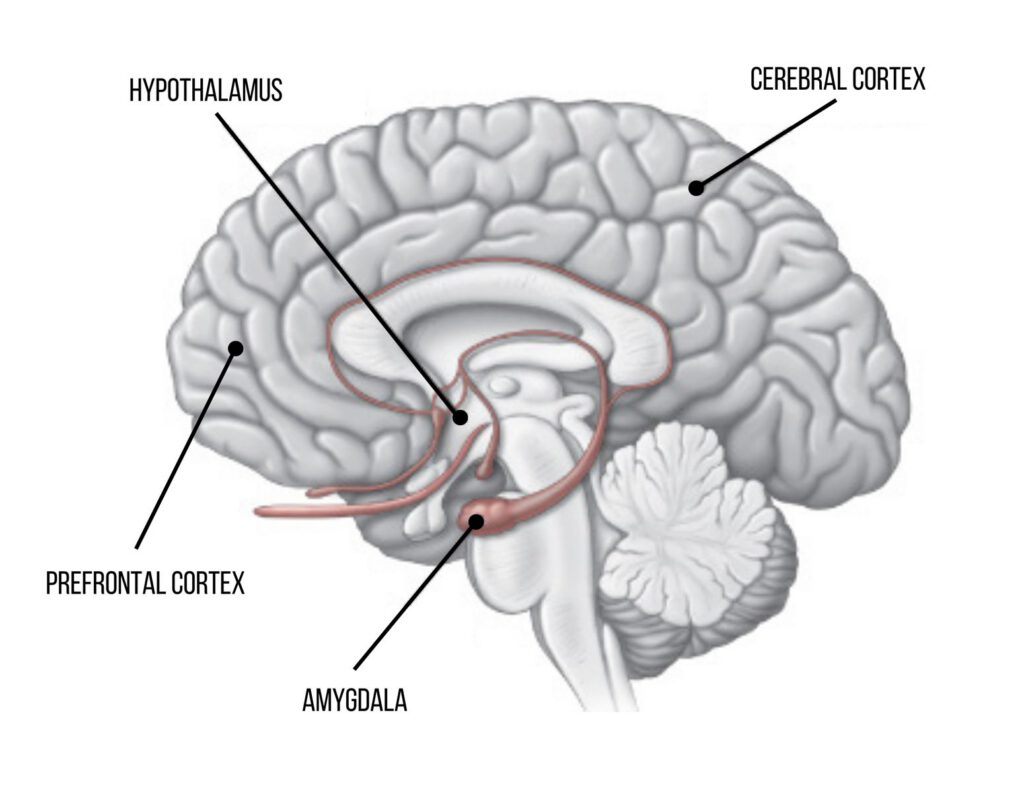
The Body’s Alarm: The Fight-or-Flight Response
When you feel fear, your brain sends a signal throughout the body that says, “Get ready.”
This is known as the fight-or-flight response — your built-in alarm system designed to keep you safe.
In an instant, the brain’s emotional center (the amygdala) takes control. It sends signals that flood the body with neurochemicals such as adrenaline, speeding up your heart rate, tightening your muscles, and elevating your senses. At the same time, the parts of the brain responsible for logic, learning, and memory (the prefrontal cortex and hippocampus) temporarily go offline.
That’s why under pressure, it can feel like you can’t think straight or that your body takes over.
You’re not broken — you’re just on autopilot. It’s your body’s natural survival mechanism doing its job.
The skill is learning to recognize when the alarm is louder than it needs to be — and training yourself to turn it down to a manageable level so that you can perform with composure, clarity, and control.
The Hidden Cost of Fear
Fear isn’t always the trembling, obvious kind. It’s often subtle.
It shows up as hesitation before taking a risk. It hides in perfectionism, overthinking, and the fear of letting others down, or the fear of other people’s opinions. It lives quietly in the what-ifs and should-haves.
And here’s the paradox — fear itself isn’t a bad thing.
Fear is information.
Fear is feedback.
Fear is a signal.
It’s the mind’s way of telling us that something matters — that we care. But when left unchecked, fear shifts from being a signal to becoming the steering wheel. It starts to dictate how you show up, how you respond under pressure, how your emotions and behaviors are triggered, and even how you see yourself.
If you’ve ever played tight, second-guessed yourself, or avoided a challenge you knew could help you grow — that was fear in the driver’s seat.
Why Exploring Fear Matters
If you’re reading this, chances are you’re curious about how fear limits us — or you care about growth, not just as a performer but as a person. That’s why exploring your fears matters — because the same barriers that limit you in sport often mirror the same ones that limit you in life.
When you build the vulnerability and courage to face your fears, you’re not just improving your performance; you’re reshaping your identity and resilience from the inside out. You’re learning to live and compete with clarity, purpose, and freedom.
Working through fear isn’t about becoming fearless. It’s about becoming mindful— learning to recognize when fear is trying to protect you, when it’s trying to limit you, and how to respond to it with courage instead of avoidance.
Like many things, working through your fears starts with awareness.
Let me show you what I mean through an exercise I often use in my practice.
What’s Holding You Back?
In this exercise, we’ll explore the fears, stressors, and mental barriers that can shape (or limit) your performance.
Ask yourself: Are the demands of your sport pulling you closer to, or further from, the person you aspire to become?
For many athletes and performers, high-level competition brings out both the best and the worst in us. It exposes our most vulnerable characteristics. It can trigger emotion, disrupt confidence, and shift our focus in ways that pull us away from who we truly are — or who we’re striving to become.
In these moments, we can become reactive, defensive, overly critical, or even selfish in the pursuit of success.
In performance psychology, we know that gradual exposure to fear — when done in a structured and intentional way — actually weakens its grip. When you repeatedly confront a fear under controlled conditions, your brain adapts. It learns. It rewires. Over time, avoidance turns into a willing approach, and anxiety transforms into confidence and control.
The longer you compete or chase excellence, the more these emotional triggers reinforce patterns that shape how you respond under pressure. That’s why awareness is critical. By identifying the fears, doubts, and insecurities that hold you back, you begin to reclaim control and realign your performance with your purpose.
Whatever you fear, remember this: To TAME it, you must first NAME it. So let’s start with self-awareness and call out what’s been holding you back.
Instead of letting fear or pressure break you down, learn to use it as fuel — a force that strengthens your mindset and moves you toward the best version of yourself, both on and off the field. Let it teach you how to bend, not break in critical moments.

The Exercise
Grab a notebook (or use the illustration above) and take a few minutes to write down your top 3–5 fears or limitations — the ones that trip you up, or limit you the most, either right now or in the past.
Think about the thoughts that show up most often before or during your performance — the inner dialogue that surfaces under pressure or in the middle of critical moments. These recurring thoughts or emotions often point to the root of your fears. Once you’ve listed them, rank each in order of their impact, starting with the one that affects you the most. This will help you identify where to focus your energy and attention.
If you struggle defining the limitations you experience, use the second illustration below that highlights some of the most common themes that hold performers back from being at their best. If needed, use it as a starting point — and feel free to add your own if they aren’t listed.

Understanding Your Fears
Internal vs. External
Now that you’ve named your fears, take a closer look at the illustration above. Do you notice any patterns or differences among the examples provided? Your fears likely fall into one of two categories — External fears (Blue Boxes) or Internal fears (Grey Boxes).
Recognizing the type of fear you’re experiencing helps you identify what you can control, what you need to release, and where your real growth begins.
External Fears
If you selected any of the fears listed in the blue boxes, you may be experiencing limitations created by external influences — factors that exist outside your immediate control. These fears often arise from situations such as a coach’s decisions, a teammate’s performance, poor officiating, injuries, or unpredictable outcomes during competition.
While these external forces can trigger emotional reactions and impact your mindset or results, they’re not fully within your power to change. In these moments, you’re essentially sitting in the passenger seat. The good news is, you can learn to accept that reality — to flush it, refocus, and move on.
Suggestion: Reinforce resilience through self-awareness by focusing your energy on what’s within your control — your effort, your adaptability, and your attitude. Anchor yourself in purpose and consistency.
For example, try using this inner dialogue and affirmation:
“No matter what happens today, I control my effort, my attitude, how I show up, and who I choose to be in this moment.”
Internal Fears
If you selected any of the fears listed in the grey boxes, you’re likely being limited by internal influences — self-imposed, self-limiting beliefs. These fears are created within your own mind through doubt, negative self-talk, perfectionism, or catastrophizing situations. They’re shaped by how you think, what you believe, and how you interpret challenges.
The good news? These are within your control. In this situation, you’re in the driver’s seat.
You have the power to rewrite the narrative.
Suggestions: Through awareness, focus on what you can control — your mindset, your preparation, and your response to pressure. This response-ability is what creates meaningful change.
Start by identifying your recurring thoughts and challenging them. Reframe negative beliefs into positive, purposeful actions.
Here are a few examples:
“I’m really nervous.” → “I’m excited for this moment and to see how I respond.”
“I’m not ready for this.” → “I’ve put in the work and I’m capable of handling what comes.”
“I failed again.” → “Failure is a teacher — there’s something here I can learn and grow from.”
“Everything feels out of control.” → “I can’t control everything, but I can control how I respond.”
This takes time, effort, and consistent practice — but remember, positive change is always possible.
Understanding Your Response to Fear
Once you’ve identified where your fears come from, the goal isn’t just to label them. The real purpose of this work is to understand them through self-awareness, so you can begin to turn down the alarm clock, tame those fears, and turn them into strengths.
When you can name what’s been holding you back, you strip fear of its power. Awareness gives you choice — and choice gives you control, particularly in how you adjust and respond. From there, you can begin reframing your fears through a process referred to as cognitive appraisal — the ability to reinterpret what a situation means to you.
Instead of viewing fear as a threat, you learn to see it as information — as feedback that can guide your focus, strengthen your preparation, and reinforce your confidence. Through awareness and reframing, fear becomes less of an obstacle and more of an advantage — a source of energy and direction rather than paralysis.
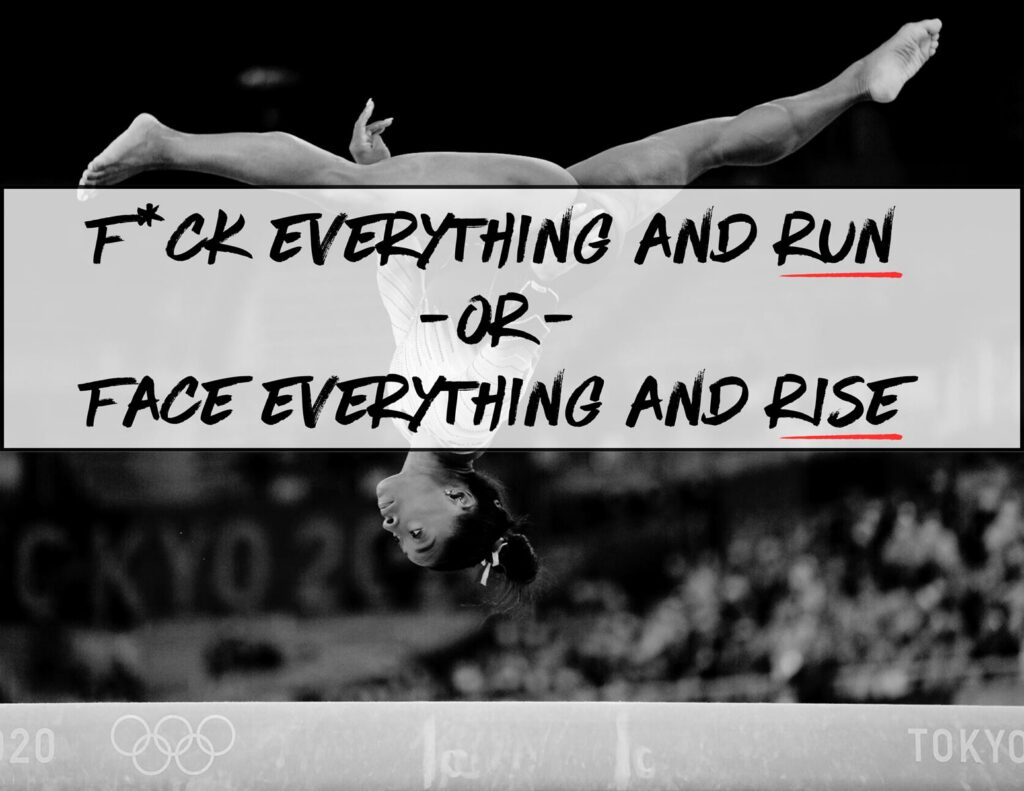
When fear strikes, people usually take one of two paths:
1) F*ck Everything And Run — avoidance, excuses, self-protection.
OR
2) Face Everything And Rise — courage, accountability, growth.
Both are natural human experiences (through Fight-or-Flight). The difference is in the details and your self-awareness. The ability to adjust and the adaptability to navigate through fear. That’s where confidence is built — not by eliminating fear, but by acting with courage despite it.
Why Vulnerability is a Performance Skill
True confidence isn’t the absence of fear, it’s a mindful approach.
It’s the willingness to be honest about what scares you — and still step forward.
That’s why vulnerability is a performance skill.
It invites truth. It allows you to align who you are with who you want to become.
And it builds trust — both with yourself and the people you lead.
The best performers I’ve worked with weren’t the most fearless — they were the most truthful.
Key Lessons & Takeaways
→ Fear is feedback, not failure. It’s a signal that something important to you is at stake.
→ To TAME it, you must NAME it. Use your word. Clarity comes from awareness.
→ It’s your Response-ABILITY. You will experience challenges and failures. It’s important to learn how to read your experiences and differentiate internal vs. external limitations. It is your response-ABILITY to control your response.
→ Reframe the story. Cognitive Appraisals are a powerful tool. Replace self-doubt with purposeful self-talk.
→ Vulnerability is strength. Truth-telling with courage unlocks growth.
I’ve spent years exploring the psychology behind greatness — and one truth stands above the rest:
Your potential doesn’t lie in becoming fearless. It lies in facing your fears with mindful intention.
Every great performer, leader, or human being has felt fear.
The difference is they didn’t let it dictate their story.
So here’s your challenge:
Be the one who confronts fear.
Be the one who rises in the face of fear.
Be the one who tells and listens to the truth — even when it’s hard.
Because on the other side of fear is freedom.
And that’s where you’ll find the best version of yourself.