-10 minute read-
Why It Matters
Have you ever felt stuck in your performance? Like no matter how hard you push, you just can’t seem to reach that next level? It feels like you’re a step behind, watching others rise while you wrestle with slow progress, frustrations or doubt. Have you ever lost confidence in the critical moments when you really needed it? Do you dominate in practice, but come game time, it feels like something’s missing?
If so, believe me—you’re not alone. These are the same questions, the very reasons I wrote this article, and a big part of why I became a mental performance coach. The competitor in me had to go exploring—to understand what truly drives winning, what I was missing as an athlete, and why the elite rise when the pressure is highest while others crumble beneath it.
For decades, experts in sport and performance psychology have emphasized the power of mental skills training to help performers unlock their full potential. It’s about far more than the old stigma of talk therapy or the surface-level idea of meditation. Ask yourself this: would you ever step into a critical game or major event giving only half your effort? Of course not. Yet that’s exactly what happens when performers pour everything into their physical readiness while neglecting their mental preparation. They end up leaving half their potential on the sideline.
True peak performance requires both — physical readiness and mental preparedness, working together as one.
Mental performance is a skill — one just as critical as your ball-handling, your pitching mechanics, or any other performance-driven skill.
As leaders, coaches, and performers, we are all in constant pursuit of greatness. A competitive pursuit I firmly believe we should never give up on. And success leaves clues — it reveals patterns. Time and time again, it’s been shown that to reach the highest levels, we must study the world’s elite performers. From their blueprint, we can build the foundation for our own mindset, goals, and strategy to reach our version of greatness.
What I’ve learned through years of working with professional athletes is that many performers genuinely lack a clear understanding of mental performance — they lack a foundation and what mental performance entails or even where to start. Because of that uncertainty, exploring the mental side of performance can feel uncomfortable, frustrating, and isolating.
Don’t worry — that’s exactly what we’ll cover in this two-part series. My hope is that by the end, you’ll have a much clearer understanding of what mental performance truly is — and a stronger sense of direction for your own development and growth.
In this first article, I’ll outline what Mental Performance Training is and what it takes to build a strong foundation — one that supports a lasting framework for success. We’ll also unpack a critical distinction: the difference between mental performance and mental health — and why both are essential resources for sustained success.
The second article will guide you forward in your mental performance journey, highlighting what to look for in a mental performance coach and shedding light on some of the most common myths that surround this work.
What is Mental Performance Training?
Mental Performance Training (MPT) is the process of developing an individualized framework that enhances mental preparedness. It is the focus, confidence, and the resilience needed to adapt through adversity. This framework begins with self-awareness — exploring an individual’s default mode — their mindset, belief systems, and core values. In essence, MPT is the foundation for achieving performance mastery.
Think about it: who wouldn’t want to be better focused? More organized and prepared? To feel unbreakable confidence in the heat of competition?
Who wouldn’t want the resilience to handle stress and chaos, the tools to continually build their skillset, or a true competitive edge? Who wouldn’t want to DOMINATE the game?
But to truly dominate the game, you must first dominate the details — because how you do anything is how you do everything.
By practicing mental skills intentionally, individuals can build the discipline and focus to perform under pressure, allowing them to enter the arena with clarity and confidence. Strengthening emotional regulation, and fostering a deep belief in a growth mindset, unlocking inner excellence, and — my favorite — living a more purposeful and fulfilling life. These skills aren’t just for athletes; they elevate performance in any area of life.
Those who make this commitment are on the path to becoming ELITE.
Those who consistently develop, and refine their mental skills are far more likely to enter flow state and master their craft. Elite performers who sharpen these skills learn how to properly manage emotions, regulate arousal, and make better decisions.
Coaches love to trust these kinds of players who take their commitment and preparation to another level. These are the high-IQ players coaches rely on when the game is on the line. They aren’t rattled under pressure — they remain focused, organized, and poised. They perform consistently, making smart decisions even through fatigue. They lead the team with composure and confidence.
When starting to develop a mental performance practice, it’s important to begin with a clear understanding of the difference between mental skills and mental tools.
Mental skills are the cognitive and emotional strategies athletes and performers integrate into their daily routines to enhance performance, manage stress, narrow focus, and support personal growth. How these skills are applied will look different for every individual, depending on goal orientations, motivational drives, individual needs, their environments, and personal strengths.
A few of these essential skills include:
- Self-Awareness
- Motivation & Commitment
- Attentional Focus & Concentration
- Discipline & Self-Control
- Confidence & Self-Efficacy
- Arousal & Emotional Regulation
- Presence / Mindfulness-Based Training
Mental tools, on the other hand, are the techniques, exercises, and strategies designed to enhance thoughts, emotions, and actions that reinforce mental skills. Common tools include:
- Goal Setting
- Mindfulness
- Routines / Winning Habits
- Visualization / Mental Rehearsal
- Music / Energy Management Techniques
- Self-Talk
- Meditation / Relaxation Techniques
- Breathing Techniques
- Concentration Techniques
- Performance Evaluation
A Critical Distinction – Where People Get Lost
As you explore the right resources for your personal development through a mental practice, it’s important to understand the distinction between mental health and mental performance.
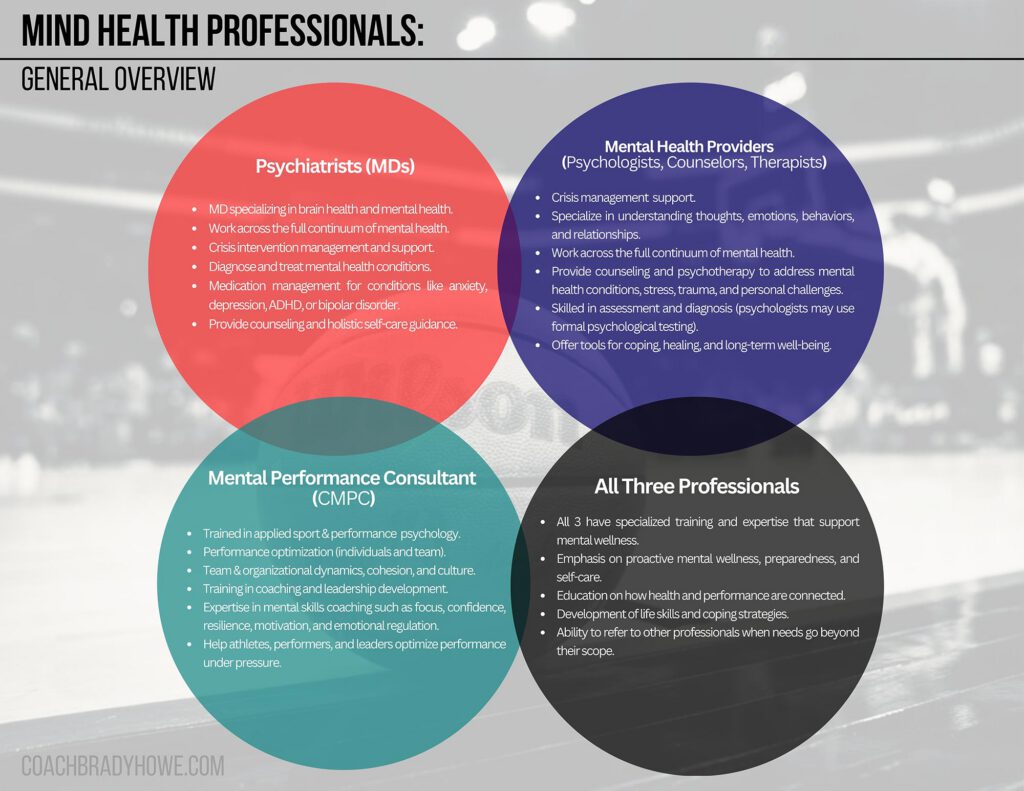
Mental health providers are clinical practitioners, such as psychiatrists or psychologists, trained in clinical psychology and medicine, with the expertise to diagnose, treat, and support individuals across the continuum of mental health. Their work and practice often involves counseling and psychotherapy, built from integrative psychological theories such as Cognitive Behavioral Therapy (CBT) or Acceptance and Commitment Therapy (ACT), tailored to address each individual’s unique needs and challenges. When appropriate, they may also provide medical interventions such as medication management. These practitioners address conditions such as anxiety, depression, trauma, or other psychological concerns, while also providing crisis management and ongoing therapeutic care. In addition, many clinical practitioners have earned subspecialties, such as sport psychology credentials, or also provide mental performance training.
Mental performance consultants (or coaches), on the other hand, are not therapists or clinicians. Their training is rooted in applied performance psychology, with a focus on developing mental skills that enhance focus, confidence, resilience, and consistency to perform skillsets. While these coaches may possess some level of educational training in clinical psychology, they generally lack the extensive clinical experience, or the thousands of hours of direct clinical training that psychologists obtain.
While both are essential, the distinction lies in intent and specialty: therapy helps individuals heal and restore well-being, whereas mental performance training equips individuals to optimize skillsets and thrive in high-performance settings.
The Takeaway Lesson: Dominate the Details
The greatest separator at the highest level isn’t talent — it’s readiness. It’s the mindset. Life and performance both come down to moments. Mental performance training is the mind-gym we use to strengthen the skills that prepare us to own those moments.
There are no shortcuts to inner excellence or personal greatness — they’re built by dominating the details, consistently. Our performance is driven through a powerful mind-body connection; and when trained intentionally, it allows us to overcome the mental blocks and barriers that often limit our performance.
The most successful, high-achieving performers began as curious explorers — of themselves, their environment, and their craft. We can learn from their blueprints, but must chart our own path. The elite are growth-minded, resilient enough to pivot and adapt, and courageous enough to embrace uncertainty. Because vulnerability isn’t weakness — it’s truth-telling with courage: the willingness to confront and live out the truth about our performance.
Coming up in Part 2, we’ll lean into the next steps of your mental performance journey — learning what to look for in a mental performance coach, exploring questions that bring clarity and direction, and confronting the common myths that hold athletes and leaders back.
Are you ready to gain the edge over the competition?
Let’s take that next step, I’ll see you in Part 2.