–10 Minute Read–
As someone who has dedicated my life exploring and studying what drives winning and enhancing human performance, one common theme stands out above the rest: Every human being wants to be at their best. Everyone wants to think, live and perform like the elite.
The difference is, only a few truly understand what it takes, and only a select few fully commit to what it demands.
I wrote this series because, as a mental performance coach who has worked with some of the world’s best athletes on the biggest stages, I’ve learned that mindset is the foundation for everything that follows. Without it, your talent, skill, and preparation can only take you so far.
At its core, our mindset is the lens through which we view ourselves, our challenges, and the world around us. It’s our perspective that shapes how we respond to what life throws our way.
Think about it, two people can face the exact same challenge and still arrive at completely different outcomes. One becomes paralyzed by fear, while the other leans in with curiosity and confidence. One views adversity as a dead end—trapped in a problem-centered mindset—while the other sees it as a bend in the road, an opportunity to adapt, grow, and improve.
Our mindset is a powerful thing — and it’s trainable. With the right tools and consistent practice, athletes who once self-sabotaged can learn confidence and composure. Leaders who panic under pressure can develop poise. Teams that fracture in adversity can learn to thrive through it.
When our mindset reaches its highest level, it becomes what I call an Elite Mindset.
An elite mindset means having an Elite Perspective. It’s having the ability to respond and engage with purpose, resilience, and clarity when it matters most.
Whether you’ve played sports or not, we’ve all witnessed athletes who embody this: the ability to consistently compete, and perform on another level, remaining unfazed by pressure or competition. Consider athletes like Tim Duncan, Lionel Messi, Derek Jeter, or Kobe Bryant—the elite competitors whose approach elevated them beyond their talent alone, enabling them to rise above any challenge. These were some of my favorite athletes to watch, because no matter the moment, you weren’t going to disrupt their poise or their ability to perform on the biggest stage.
Let’s be clear, before we go any further, know this: developing an elite mindset isn’t easy, but it is achievable. Every person’s path to personal greatness is unique, and so is the mindset and the tools that will get them there. Reaching this level doesn’t happen overnight, and it may never be a destination we fully arrive at — but it’s a journey worth committing to.
From my experience, an elite mindset is what enables the best athletes and teams to learn faster, adapt quicker, and execute higher than the competition. It transforms uncertainty into possibility, failure into feedback, and setbacks into comebacks. The elite performers don’t wait for circumstances to define them, they choose to define the moment.
The question is: Why wouldn’t you want it to be elite?
Ask yourself, what would it look like if your mindset matched your goals? If your daily habits aligned with the legacy you hope to leave behind? Because the truth is—your results will always rise or fall to the level of your mindset (and training). Developing an this mindset begins with self-awareness—recognizing that every moment offers a choice in how we show up. Who we choose to BE in the world.
When I begin working with clients on building their mental performance framework, I like to start with a specific lesson — an analogy that shapes how we show up in the arena of life. It’s lesson is a simple but powerful truth: the difference between those who achieve success and those who merely observe it often comes down to their mentality when they step on the court.
The Player vs. Spectator Mentality
With the goal of developing an Elite Mindset, I introduce this particular lesson early in my practice because it’s an analogy that sets the tone for everything that follows. I call it the Player vs. Spectator mentality — an analogy that illustrates the difference between living passively and showing up with the presence, focus, and the ownership required to develop an elite mindset.
Keep in mind, most of my experiences come from working with elite performers at the professional level in the NBA. And while the lessons and examples I share are rooted in that high-performance environment, they apply universally and hold value to any setting.
To bring this analogy to life, imagine you’re at an NBA game—or any sporting event. On the court are players who are fully engaged, actively competing, and directly influencing the outcome. Their presence is felt. Their decisions matter.
At the same time, there are spectators in the stands, watching from a distance, emotionally invested but not physically contributing. While the spectators may cheer, critique, or react to what unfolds, their role is diminished, and passive. They are observers, not contributors. They experience the game, but they don’t play it. They have zero control over the outcomes.
The difference between these two scenarios couldn’t be more clear. Both of these groups are in the arena, but the mindset, behaviors, actions taking place as a player on the court is fundamentally different from the spectators observing in the stands.
When you are a player, the outside world fades. The noise of the crowd disappears. You’re locked in on your assignment, trusting your preparation, and letting your instincts take over. Your focus narrows. You’re present, hyper-aware, and fully committed to the moment in front of you. You’re not just participating, you are competing in attack mode.
Comparing these two mindsets, what do you notice about their level of focus, impact, or emotional investment? It completely changes the way they experience the moment.
Being a player means being locked in, fully present. You are an active contributor taking the initiative, staying engaged, and adjusting to challenges as they unfold. It demands ownership, accountability, and the willingness to step into discomfort in order to develop and grow.
Being a spectator, on the other hand, you may be physically present but mentally distant. You are not part of the outcome. You are comfortable, and complacent. Observing opportunities pass by without engaging or taking action.
The Player vs. Spectator analogy isn’t just about sports, it’s a metaphor for how we live, and lead our approach to life (or our performance). So consider a few key areas in your life. Are you being more of a player or spectator?
- In your family or relationships?
- In your personal growth, such as goals or aspirations?
- In your health and wellness?
- In your finances, schooling or profession?
- In your spirituality?
- Within your team or your community?
Take a moment and reflect on your life, your goals and current circumstances: Are you showing up like a player—engaged, focused, proactive, and on the attack? Or are you falling into default mode as the spectator —passive, reactive, distracted, and watching from a distance? Only one version leads to creating an impact—controlling what we can control.
That’s why in my practice and approach, we begin here—with you and your mindset. The more you embody these principles in daily practice, the more they shape emotional regulation, build self-confidence, and develop true mental strength.
The takeaway lesson: Get on the Court
Being a player isn’t a one-time decision. It’s a daily choice:
→ To step up, focus, and act in the areas you can control.
→ To embrace challenge, responsibility, and accountability.
→ To shift from being reactive to being proactive.
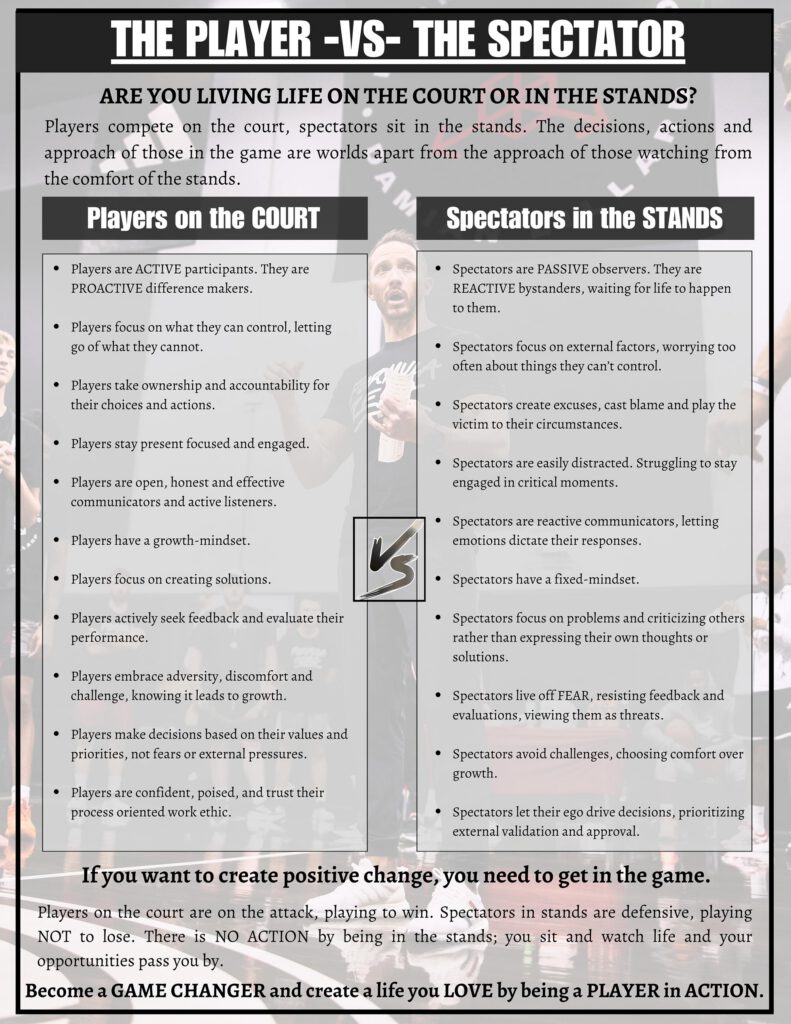
The Player vs. Spectator mentality is a lens you can apply anywhere—in sport, leadership, or everyday life. And mastering it sets the stage for the next evolution of an elite mindset — understanding what kind of player you are, and how the choices you make each day, and under pressure define your performance and lifestyle.
Coming up in Part 2 of this series, we’ll take that next step. We’ll look at what kind of player you naturally become once you enter the court. I’ll introduce a concept I call The Predator vs. Prey—the mindset that separates those who attack and win from those who play it safe. We’ll also tackle common myths and misconceptions about mindset that hold so many people back.
Are you ready to take the next step? I’ll see you on the court.