-15 Minute Read-
In the athletic world, every great coach has an organized system—a game plan, a playbook. You see it on the sidelines of football games, those color-coded sheets clutched in the coaches hands, the result of hours of preparation that guides them for every possible scenario. That playbook is their anchor, a defined method that allows them to execute with confidence when the pressure rises. The same principle applies beyond the field.

What is a Mental Playbook?
A mental playbook is the tool I developed and use with the athletes and clients I serve to help them get organized, establish a plan and develop strategies that allow them to step into their moments with the clarity and the confidence to execute—no matter what life or sport throws their way.
As you read, you’ll notice throughout this article, I’ll use the terms ‘Mental Playbook’ and ‘Mental Skills Playbook’ interchangeably. They represent the same concept—the idea of building an organized process to guide your approach.
The playbook is a critical tool that gives athletes and high performers a structured way to reflect, study, and prepare which mental skills and tools best serve them in their environments. This isn’t a one-size-fits-all checklist; it’s a personal game plan that can be customized to highlight the habits of excellence most relevant to you. Just like coaches or football players who build playbooks and schemes each week to prepare for what’s ahead, your mental playbook is fluid—something you can adjust and adapt to meet the demands of your life, your sport, and your pursuit of being your best self. For some, that might mean sharpening mental skills such as focus, self-talk, visualization, adaptability, or mental toughness. For others, it might be mastering the tools that support those skills—such as routines, goal-setting, breath work, mindfulness, or journaling. A playbook doesn’t just tell you what to use; it helps you know when to put each tool into play so you can execute consistently and with purpose. Because when you are prepared, you feel confident.
The value in building and integrating a mental playbook is recognizing the power of an organized process that begins with self-awareness. It means creating a plan you can rely on in any situation—whether it’s managing pre-game anxiety, quieting negative self-talk, controlling your emotions after a tough call, or moving forward after a poor performance. A mental playbook provides that structure—a clear, repeatable system that brings order and clarity. By embedding process-based actions into your daily routine, you set yourself up for steady progress, better decisions, greater consistency, and long-term success.
The lesson behind this tool emphasizes that without self-awareness and structure, mental skills become sporadic, underused or forgotten when the chaos unfolds and adversity hits. Developing a clear mental framework turns scattered tools into a system athletes can trust when they truly need it the most.
So what does this tool really look like in practice? To bring this concept to life, let’s look at it in action. Below is an example of a mental playbook template that shows how this framework takes shape.
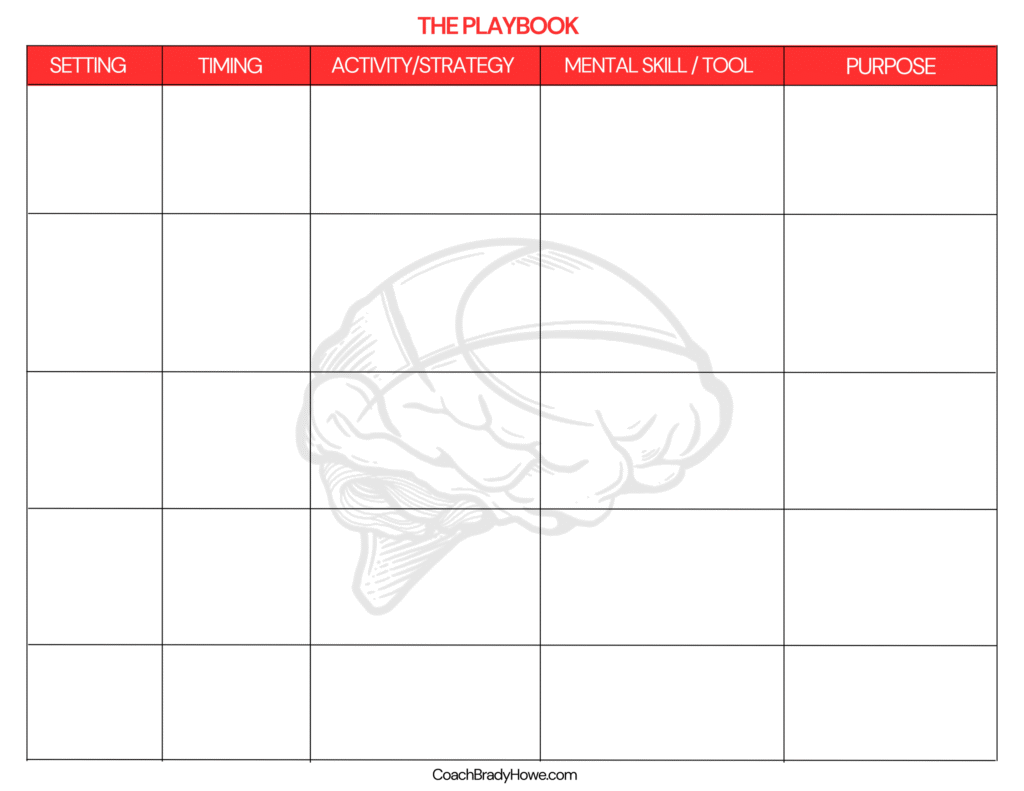
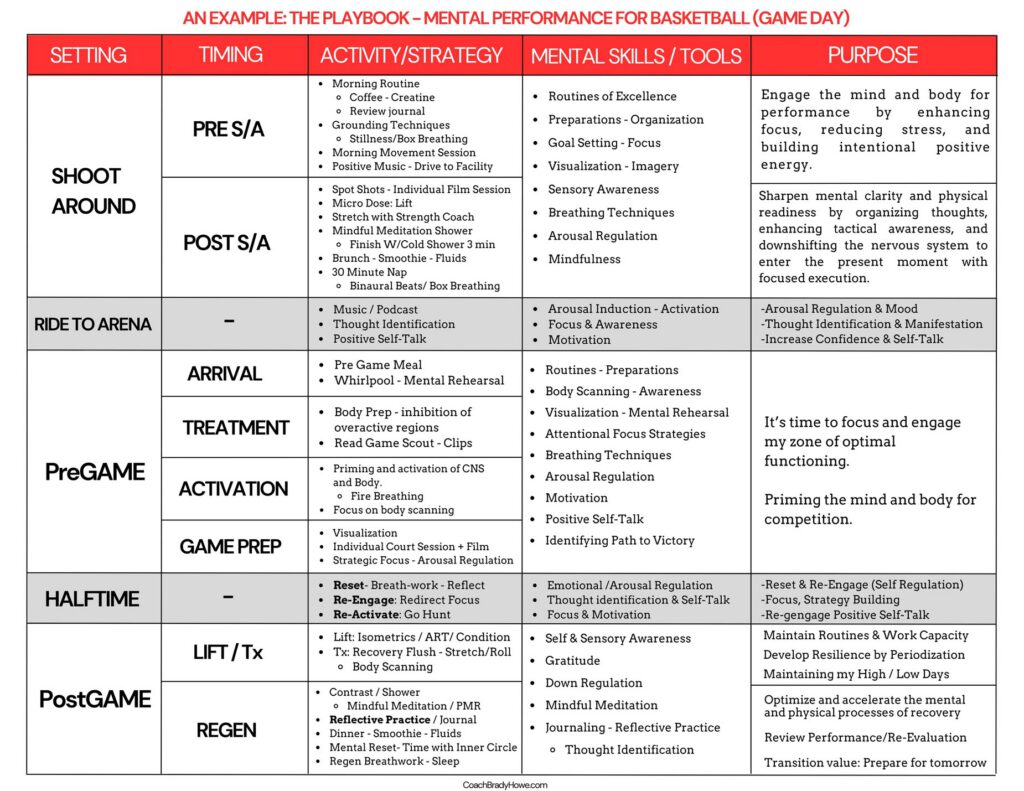
The Playbook provides a visual framework that gives you an organized way to know when, where, and why to put specific skills and routines into action. In the example below, you’ll see how a professional basketball player uses a mental playbook on a practice day to build a process-oriented approach. By identifying the key settings and moments throughout the day, the athlete integrates the mental skills, routines and tools that help regulate energy, sharpen focus, and establish routines—creating a sustainable practice that sets the stage for consistent, positive outcomes.
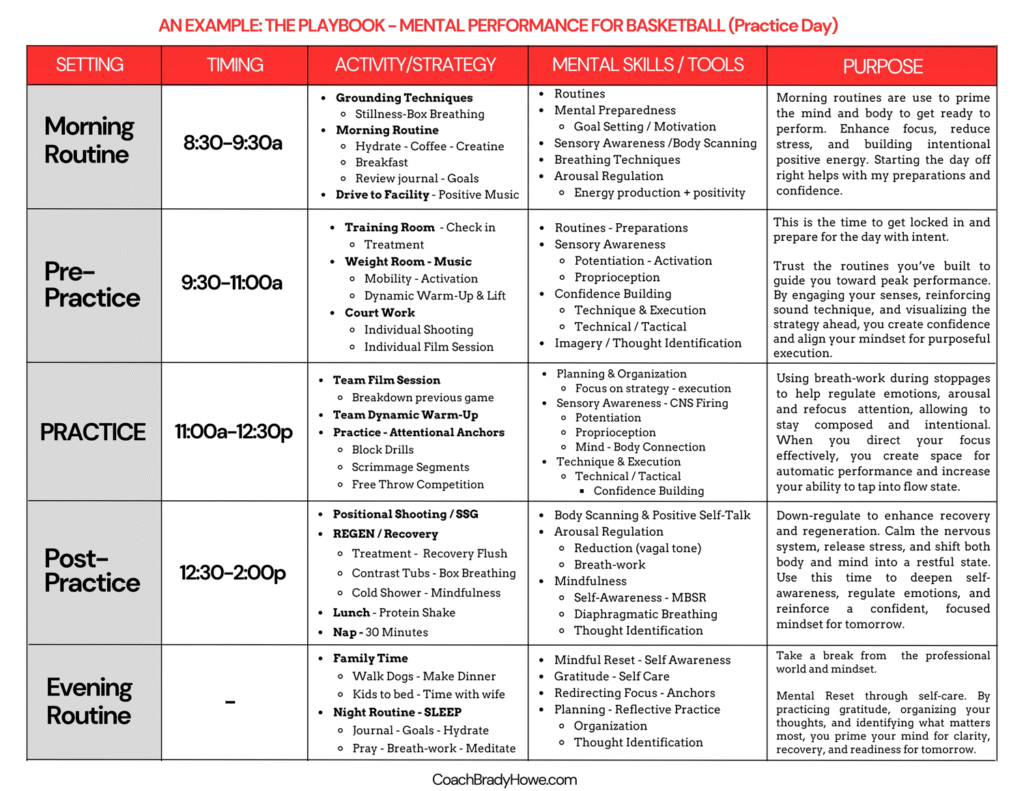
You can use this same approach to map out the routines, and strategies that give you the best chance to perform at your best. Below is another example of a professional basketball player who carefully structured their game day, identifying the habits and tools that set them up for success. Now, as a reminder, this is just an example—your needs, your challenges, your tasks, and your PLAYBOOK will be different.
What would your ideal Mental Playbook look like?
Let’s start breaking down how to build the ideal process and playbook for your performance.
Core Components of a Mental Playbook
Now you have seen the concept and a few examples, the question is… “How do you actually build a mental playbook?”
Just like a coach breaks down their game plan into schemes, the first step in creating your playbook begins with self-evaluation. Knowing yourself, your challenging, and your environments. For many this is an on-going exercise that requires trial and error throughout their entire career, learning what works and what doesn’t. Similar to how coaches study and evaluate the upcoming opponents, and design sets and plays to prepare for any situation, you reflect on the demands of your training, your sport, or performance and use that awareness to tailor a specific game plan built on the mental skills and tools that optimize your ability to perform.
This tool is about organization, creating your preparedness.
For example, let’s say you have a big game or presentation coming up and you start to feel those nerves kick in. You already know what usually happens—your physiology takes over with a pounding heartbeat, dry mouth, and butterflies in your stomach. You may even feel weak and overly distracted. At the same time, your mind races with negative thoughts, fear, and doubt, leaving you feeling overwhelmed before the moment even begins. With a playbook in place (and practiced), you would have already identified this pattern and intentionally planned your performance routines. That could mean stepping away for a quick walk, integrating a mindful approach with box breathing, pairing it with binaural beats or calming music, and giving yourself a reliable reset strategy. Instead of leaving your performance up to chance, you’d have a proven plan to step into the moment with confidence and control.
When you have an organized process you start to learn exactly what you need in these critical moments. Whether you become overstimulated and need to integrate tools that down-regulate your nervous system, or you find that you need a little boost to jumpstart your nervous system, re-engage your focus, and create the energy needed to step-up and perform with confidence.
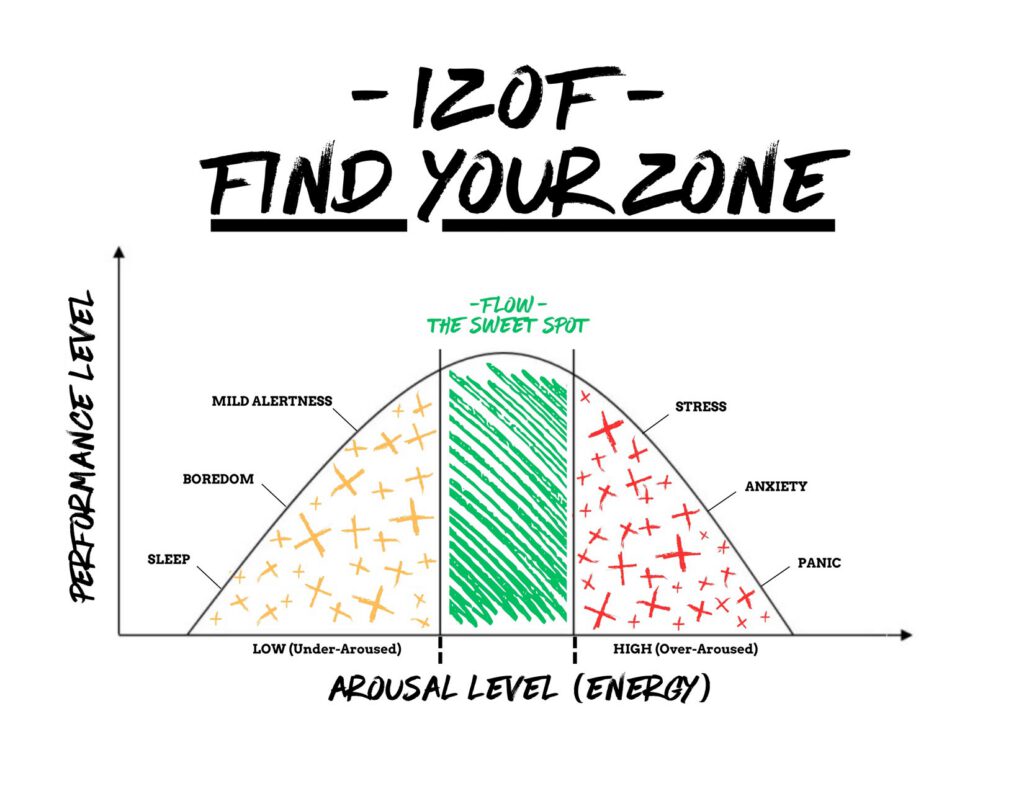
This ties directly into the concept of the Individual Zone of Optimal Functioning (IZOF), developed by sport psychologist Yuri Hanin (1978). It’s the theory that we each have a personal ‘sweet spot’ of arousal where we perform at our best. As you will notice in the illustration below, what IZOF teaches us is that having too little energy can leave us flat and unfocused, while too much can lead to tension, overthinking, and panic. Both of which can be a detriment to our performance. The key is learning how to fine-tune your process, routines, and skills so you can consistently generate the optimal level of energy and the physiology to show up and deliver when it’s time to perform.
Learning where your zone is—and how to consistently get yourself there is a key part of training your mental playbook.
The evaluation process is a critical first step. When you learn how to break things down, analyze, and prepare, you gain a clearer understanding of yourself—your needs, your environments, and the challenges you most often face (or soon will). From there, the Mental Playbook begins to self-organize your approach into clear, practical components. It’s not theory—it’s strategy. The pages of your playbook should capture the mental skills you need most, the tools that support them, and the routines that bring them to life. When you see it written out, you begin to notice the patterns, strengths, and blind spots that influence your performance. That recognition develops into a system you can trust.
Up next, we take this a step further and walk through the self-evaluation process itself, breaking it down into steps that will guide the creation of your Mental Playbook.
Step by Step Process to Building Your Mental Playbook
The foundational step – EVALUATE: As we’ve touched on already, self-evaluation is the critical first step in building your Playbook. This requires honest reflection and a willingness to break everything down into key components—such as your strengths, your tendencies, your environments, and the challenges you face.
When you deconstruct (or breakdown) your performance into its critical parts, you gain a clearer understanding of how it all works—leaving nothing to chance. This level of preparation builds awareness, so when your performance begins to fall apart, you know how to self-correct and get back on track with confidence. This is exactly where the best athletes in the world separate themselves—through relentless preparation and studying every move and tendency of their opponents. They know the schemes that will work, the limitations that may hurt them, and how to analyze it all at a levels that fuels unshakable confidence in their plan of attack.
Let’s explore a few additional components of the self-evaluation process to consider, so you can create a playbook that is truly personalized, and actionable. Of course, this is not an exhaustive list, but it is a great starting point to consider. Through this process, use what works for you, and discard what does not.
1. Evaluate YOURSELF:Spend time reflecting on critical questions that can help guide an internalized process of self-evaluation.
→ What patterns, routines, or behaviors have helped set me up for success?
→ On most days, am I performing at my best, or falling short of my potential?
→ How do I typically respond to mistakes, setbacks, or high-pressure situations?
→ How do I handle stress or pressure situations—do I thrive, plateau, or struggle?
→ Do I bounce back quickly from setbacks, or do they throw me and my game off course?
→ What are my strengths, areas for improvement, or blind spots that could be exposed under pressure?
→ Inner Dialogue: Whats my typical thought process or self-talk like before, during, and after I perform?
→ How is my confidence level going into practice, or game (high, mid, low)? What factors influence that?
→ Performance Mindset: Whats my typical mindset, energy, and focus like during competition?
→ Is it more positive (helping performance) or negative (harmful to my performance)?
2. Evaluate your CHALLENGES: Consider what holds you back from being able to perform at your best.
→ What fears, doubts, or insecurities tend to arise at critical moments?
→ How do I respond mentally, emotionally, and physically when under pressure?
→ What can I do differently to prevent small issues from turning into big setbacks?
→ Which obstacles do I often face that are within my control, and which are outside my control?
→ What challenges do I face most often and have the greatest impact in training or performance?
→ What strategies have worked in the past to overcome obstacles? What helps me adjust quickly?
→ How do I currently spend my time and energy when confronting challenges—proactively or reactively?
3. Evaluate your ENVIRONMENTS: Our environmental surroundings are important to our ability to perform and live with confidence. This concept is known as the biopsychosocial model which highlights how a persons biology, psychology and social environments play a crucial role in influencing their ability to perform at their best – something we see clearly in both sports and everyday life. Take time to analyze what environments motivate or drive you to push your limits.
→ What are the recurring themes of my day-to-day life (practice, game, travel, rest, recovery)?
→ Which environments help me perform at my best, and which hinder me?
→ How can I structure my day to prioritize focus, energy, and recovery?
→ How do teammates, coaches, colleagues, or family impact my performance?
→ Where can I practice mental routines consistently within my environments?
→ Where do I have control over my surroundings, and where do I need to adapt?
→ How can I maximize opportunities in each environment to improve performance?
→ How can I leverage supportive environments and relationships to enhance my performance?
→ How can I intentionally shape my environment to align with my goals and peak performance?
→ What is my preferred communication style? How do I prefer to be coached to perform my best?
→ What social distractions consistently interfere with my performance, and how can I limit them?
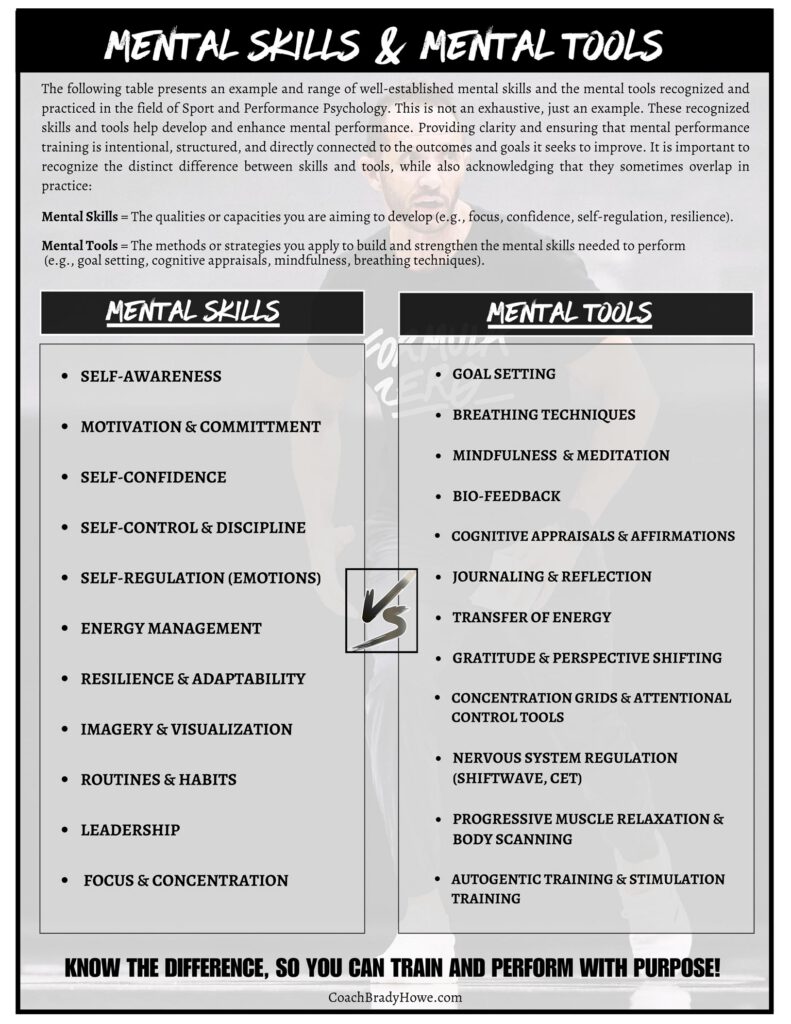
4. Evaluate your current Mental Skills & Tools:In this step, take the time to honestly evaluate your current mental skills and tools. Identify what comes naturally to you, what you already use, and what new strategies could benefit your practice and performance. Be open to discovering skills you weren’t aware of—these insights may help you understand which resources can truly support your development and growth.
If you’re truly a beginner and unsure where to start in this process, don’t worry or feel uncomfortable—these are the very skills and tools I spend hours working through with professional athletes, helping them get organized and understand which strategies work best for them. To help illustrate the difference between mental skills and mental tools, refer to the illustration shared in the visual below. Here are some guiding prompts to help with your evaluation:
→ What 3–5 mental skills or tools have you relied on or used most in the past to support your training?
→ Which mental skills have helped me perform well under pressure in the past?
→ What tools, routines, or exercises support each of these mental skills?
→ How can I integrate these tools into my daily routine for consistency?
→ Which skills do I struggle with consistently and need to strengthen?
→ Which skills or tools should be my priority for the next 30–60 days of focused improvement?
→ What tools or resources (apps, music, mentors) do I believe can support my mental skills the most?
5. Outline the Mental Skills and Tools you NEED:By this point, you’ve gathered a great deal of information from your evaluation process, as well as insights into the mental skills and tools you’ve used (or haven’t used) in the past. Hopefully, this hasn’t been an overwhelming experience, but if it has, embrace it—and recognize that you have the ability to use this process and playbook to your advantage. This entire process highlights just how valuable a tool like the Mental Playbook can be in helping you get organized and better prepared in your practice and approach.
This is where your Playbook really begins to take shape. Now we begin identifying the mental skills and tools that will have the greatest impact on your performance. Here, everything comes together as you outline the specific skills and strategies that can best support your growth and performance at this stage of your journey. As you have seen, there are countless skills and resources to explore, but let’s start with a simple approach.
→ At this moment, what 3–5 mental skills would elevate my training, practice, or performance the MOST?
→ In general, what 3-5 mental skills or tools do I believe are MOST critical for performing at a high level?
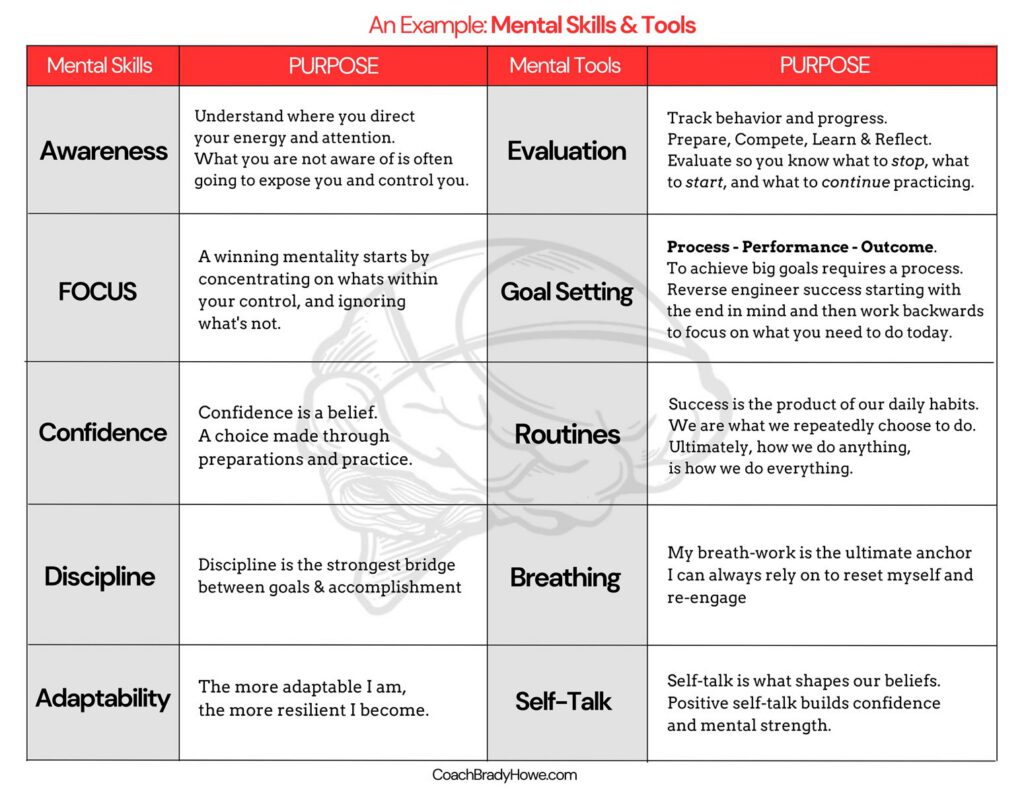
Below is an exercise and example I use with many of my athletes to highlight the skills that will best serve at this moment or within this season. Each skill is carefully chosen with purpose—designed to help you stay organized, focused, confident, and composed in training, and high-pressure competition. By identifying the tools you need—and understanding the purpose behind them—you create a consistent, actionable system you can trust when it matters most.
6. Make your Playbook Visible: You need to see it to believe it: Now you have put all this work into compiling and organizing your mental skills playbook, let’s make sure you keep it in plain sight as a constant reminder. Place your playbook where you know it will serve as a positive reminder—such as in your locker, the passenger seat of your car, or even taped to your bathroom mirror.
Remember, seeing is the first step to doing. When you see it, you live it.
Research shows that writing out your plans strengthens the brain’s ability to encode and retrieve information, rewiring neural pathways in ways that leave you more prepared and confident when it’s time to perform. Beyond writing, there’s also tremendous value in visual reminders. When athletes see their goals, affirmations, or game plans displayed—whether on lockers, shoes, or play sheets—it creates an attentional focal point and anchor that reinforces consistency and composure under pressure.
7. Deliberate PRACTICE: This cannot be emphasized enough, Practice… Practice… Practice…
Just like our football coaches who spend countless hours studying film and designing a playbook and game plan for our success, now it’s our turn to execute—and that starts with practice.
Key Takeaways
→ Self-awareness is the foundation: Understanding your strengths, weaknesses, and patterns allows you to build a playbook and the develop the skills that works for you.
→ Process over outcomes: A mental playbook is simply developing mental preparedness. A structured system that organizes the skills, tools, and routines to ensure consistent performance, even under pressure.
→ Mental skills are universal: Mental skills and tools are critical to your success as a performer. Focus, confidence, visualization, and resilience aren’t just for athletes—they support peak performance in any area of life. What mental skills are goin to best serve you at this moment?
→ Practice makes it real: Building your playbook is a critical step toward confidence and preparedness. But once it’s structured and in place, the real work begins—practicing, rehearsing, and drilling it into action until it becomes second nature. Only then will you be able to adjust, adapt, and respond quickly enough to outperform the competition and trust the tools you’ve built to perform.
→ Environment matters: Making your playbook visible and designing supportive surroundings reinforces habits and mental routines.
The true value of a Mental Skills Playbook is that it helps you get organized. It creates a personalized framework built around tools and skills you can consistently rely on, setting you up for success in any situation.
In this article, we covered the WHY, the HOW, and the WHEN—not only to create your Mental Skills Playbook but also WHERE to put it into action. Keep in mind, what I’ve shared here is just a starting point, a framework. In practice, I work with athletes to refine their Mental Playbook into a individualized, detailed system built around their unique strengths, challenges, and goals.
The good news is that you now have a powerful tool to implement and put into practice, now let’s unlock the results.
Remember, greatness is a process, not a promise.
If you found value in this article and are ready to elevate your process and playbook a step further, let’s connect. I’ll show you how to turn your playbook into a powerful tool that takes your performance to the next level.
Are you ready to dominate your performance? – Let’s get to work.